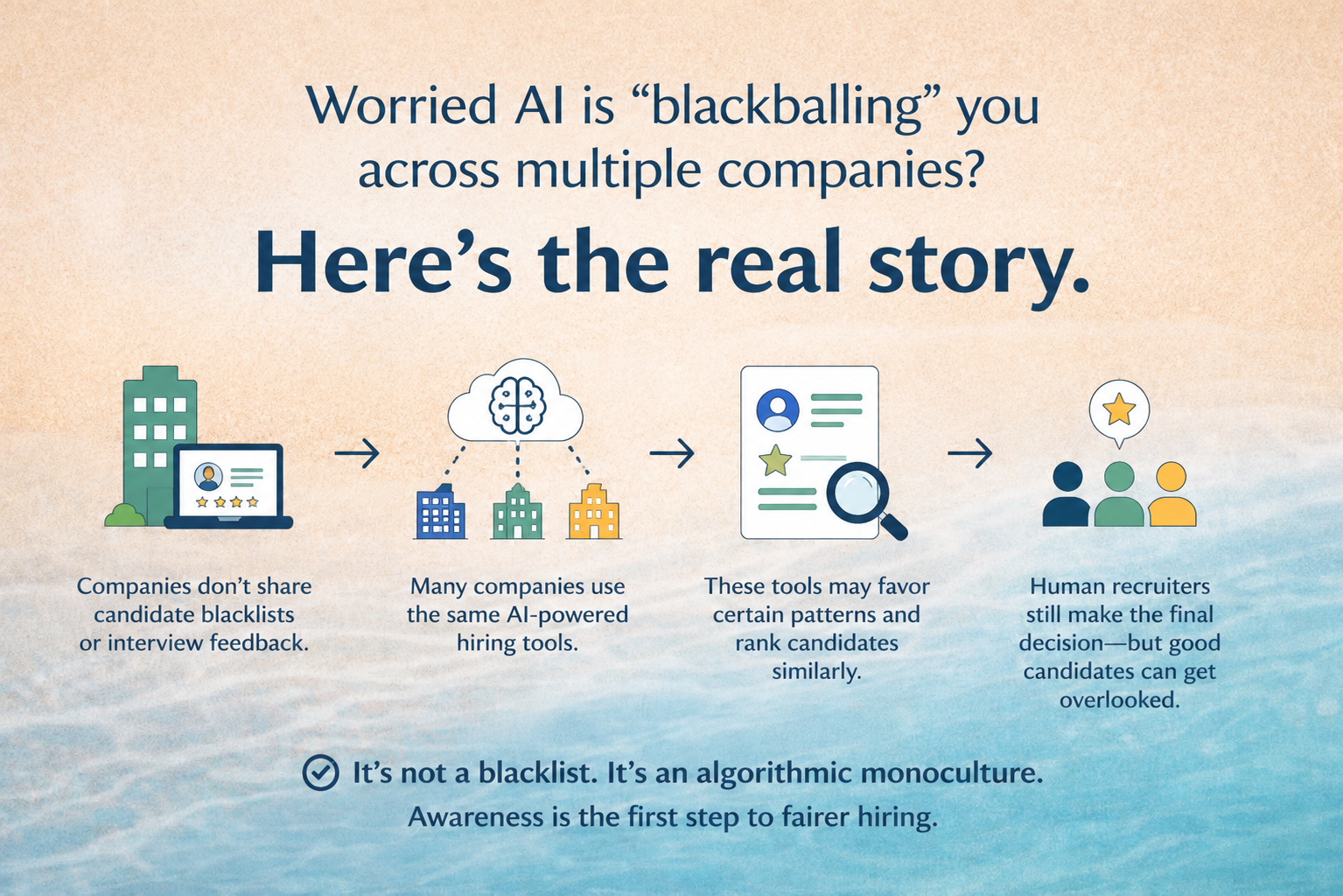
Is AI Blackballing Candidates Across Multiple Companies?
Recently, a study from Stanford sparked headlines suggesting that AI hiring tools may be creating an "algorithmic monoculture"—a world where candidates rejected by one company are more likely to be rejected by others using the same technology.
As often happens with studies like this, the headlines are a little scarier than the reality.
Let's talk about what's actually happening.
First: Companies Are Not Sharing Candidate Blacklists
One of the biggest misconceptions I see is the idea that if Company A rejects you, that information somehow follows you to Company B.
In almost all cases, it doesn't.
Interview notes, recruiter feedback, hiring decisions, and candidate records are private to each employer. If you interviewed at one company and received feedback that you weren't the right fit, another employer cannot see those notes.
There is no giant database where recruiters are leaving comments about candidates for other companies to review.
So if you've been worried that one bad interview is following you around the job market, take a breath. That's not how modern recruiting systems work.
So What Is the Stanford Study Talking About?
The concern is less about shared information and more about shared technology.
Many organizations use the same third-party recruiting platforms, sourcing tools, and AI-powered matching systems. These tools may use similar models to determine which candidates appear to be strong matches for a role.
Think of it this way:
If 500 companies use the same recommendation engine, that engine may consistently favor certain career paths, educational backgrounds, job titles, or resume structures.
Candidates with more unconventional backgrounds may be ranked lower repeatedly—not because companies are sharing information about them, but because the same assumptions are being applied over and over again.
That's what researchers mean by an "algorithmic monoculture."
Could AI Learn From Previous Hiring Decisions?
Potentially, yes—but not in the way many people imagine.
Most AI vendors are not training their systems on your specific interview feedback from another employer.
However, some models may learn from aggregate hiring outcomes over time.
For example, if a system observes that certain profiles are consistently advanced, interviewed, or hired, it may become more likely to recommend similar profiles in the future.
The risk is not:
"Company A said this candidate wasn't good enough."
The risk is:
"The model has learned that candidates who look like this candidate historically get hired less often."
That's a subtle but important difference.
What This Means for Candidates
The good news is that most hiring decisions are still made by humans.
Despite what social media may suggest, AI is not secretly making final hiring decisions at most organizations. Recruiters, hiring managers, and interview teams are still responsible for deciding who advances through the process.
AI is typically being used to:
Surface candidates
Recommend matches
Summarize resumes
Prioritize applications
Assist recruiters with large applicant volumes
The challenge is ensuring that qualified candidates aren't overlooked simply because they don't fit a traditional pattern.
What This Means for Employers
The answer isn't to eliminate AI.
The answer is to use it responsibly.
Organizations should regularly evaluate:
How candidates are being surfaced
Whether nontraditional backgrounds are receiving consideration
Whether hiring outcomes show signs of bias
Whether recruiters are relying too heavily on recommendations
Whether humans remain actively involved in decision-making
Technology should help recruiters make better decisions—not make decisions for them.
The Bottom Line
The biggest takeaway from the Stanford study isn't that AI is blackballing candidates.
It's that when many organizations rely on the same technology, they may unintentionally overlook the same people.
That's a hiring challenge worth paying attention to.
But it's very different from the idea that candidates are being secretly tracked or blacklisted across employers.
As with most things in recruiting, the truth is more nuanced than the head
Need help navigating these new waters, please reach out! I would love to talk!
Christine Sharma
Founder: Salty Dog Talent Consulting
email: Christine@saltydogtalent.com
The Candidate Experience Isn’t a “Nice to Have”—It’s Your Hiring Strategy
Let’s be honest: most companies think they deliver a great candidate experience.
They don’t.
And in today’s market—where candidates are more informed, more selective, and more vocal—that gap is costing you hires, reputation, and revenue.
At Salty Dog Talent Consulting, we believe candidate experience isn’t about being “nice.”
It’s about being intentional, structured, and respectful of people’s time and energy.
Here’s how to actually deliver a top-notch candidate experience—without adding fluff or slowing down your process.
🌊 1. Start With Clarity (Before You Ever Post the Job)
A great candidate experience starts before a candidate applies.
If your internal alignment is messy, your external experience will be too.
What to get right:
Clear must-haves vs. nice-to-haves
Defined interview stages and who owns each step
Structured scorecards tied to real competencies (not gut feel)
Compensation range you’re actually willing to stand behind
Salty Truth:
If your hiring team isn’t aligned, candidates will feel it immediately—and they will opt out.
🐚 2. Respect the Application Process (No Black Holes)
Nothing damages your brand faster than silence.
Candidates are investing time, energy, and often emotional bandwidth into your process. The least you can do is acknowledge it.
What “good” looks like:
Confirmation email that feels human (not robotic)
Clear expectations on timeline and next steps
No unnecessary hoops (assessments, duplicate data entry, etc.)
Quick win:
If a candidate isn’t moving forward, tell them. Promptly. Kindly. Clearly.
🌅 3. Design Interviews Like You Actually Value People’s Time
Too many interview processes are long, repetitive, and unclear.
That’s not rigor—that’s inefficiency.
A strong interview experience includes:
A clear agenda shared in advance
Interviewers who know their role (no duplicate questioning)
Consistent, structured evaluation (scorecards > opinions)
Reasonable number of stages (hint: 4–5 is usually plenty)
Salty Truth:
If your interviewers are “just winging it,” your candidates know.
🐾 4. Train Your Interviewers (Yes, Really)
Your interviewers are your brand during the hiring process.
And most have never been trained.
What matters:
How to ask consistent, competency-based questions
How to create a welcoming, conversational environment
How to avoid bias and stay focused on evidence
How to sell the role and company authentically
Pro tip:
Great candidates are evaluating you just as much as you’re evaluating them.
🌊 5. Communicate Like a Human (Not a System)
You don’t need fancy tools to create a great experience—you need better communication.
Do this:
Set expectations and then meet them
Follow up when you say you will
Be transparent about delays or changes
Personalize where it matters (especially in later stages)
Salty Truth:
“Ghosting” isn’t just rude—it’s a signal your process is broken.
🐚 6. Make the Decision Process Tight (and Fair)
Slow, unclear decision-making is one of the biggest candidate experience killers.
What to focus on:
Debriefs that happen quickly after interviews
Decisions based on structured feedback—not the loudest voice in the room
Clear hiring criteria tied to business outcomes
Bonus:
When your process is structured, your offers are stronger—and your acceptance rates improve.
🌅 7. Close the Loop—For Everyone
Whether a candidate gets the job or not, the experience should end with clarity and respect.
For finalists:
Thoughtful, specific feedback (when possible)
A clear and compelling offer conversation
For those not selected:
Timely communication
Respectful tone
No vague, copy-paste rejection emails after multiple rounds
And definitely do not send a survey before the candidate knows exactly where they stand.
Salty Truth:
Rejected candidates are still future applicants, referrals, and customers.
🐾 The Bottom Line
A great candidate experience isn’t about adding more steps—it’s about designing a process that actually works.
When you get it right:
You move faster
You hire better
You build a reputation that attracts top talent
And when you don’t?
Candidates talk. Loudly.
🌊 How Salty Dog Can Help
If your hiring process feels:
Slower than it should be
Inconsistent across teams
Overly manual or unclear
Or just not delivering the results you need
We can help you bring clarity, structure, and calm to the chaos.
Because great hiring isn’t luck—it’s design.
Salty Truth Friday: If You Can’t Measure It, You Can’t Fix It.
If you don’t know:
Time-to-fill
Stage duration
Offer acceptance rate
Scorecard completion %
Hiring manager responsiveness
You’re guessing.
And guessing in hiring is expensive.
Data isn’t bureaucracy.
It’s visibility.
And visibility creates leverage.
Takeaway:
Measure what matters. Improve what you measure.
Salty Truth Friday: “Culture Fit” Is Not a Hiring Strategy.
When interviewers say:
“I just didn’t feel it.”
That’s not data.
That’s ambiguity.
Culture fit, when undefined, becomes:
Bias
Inconsistency
Legal risk
Poor diversity outcomes
If culture matters (and it should), define it.
What behaviors?
What decision-making style?
What collaboration expectations?
Vibes don’t scale.
Structured evaluation does.
Takeaway:
Define culture in behaviors, not feelings.

What Happened When We Implemented Structured Scorecards
Hint: It wasn’t just better interviews.
By Christine Sharma
Founder, Salty Dog Talent Consulting
When I suggest structured scorecards, I usually get one of two reactions:
“That sounds bureaucratic.”
“Our managers won’t do that.”
Both are understandable.
What most teams don’t realize is this:
Structured scorecards aren’t about documentation.
They’re about decision quality.
Here’s what actually happened when we implemented them the right way.
The Starting Point
The company was scaling quickly.
Hiring managers were stretched.
Recruiters were juggling multiple roles.
Interviews were happening — but alignment wasn’t.
What we saw:
Scorecard completion hovering around 42%
Feedback submitted an average of 3–5 days late
Time-to-fill averaging 61 days
Frequent “reopen” searches due to misalignment
Debriefs lasting 60+ minutes with no clear decision
The process wasn’t broken.
It was undefined.
And undefined systems create expensive inconsistency.
Step 1: Define What “Good” Actually Looked Like
Before touching the ATS, we clarified competencies.
For each role, we defined:
4–6 core skills tied directly to performance outcomes
Clear behavioral indicators
What strong vs. weak responses looked like
Which interviewer owned each competency
This shifted intake meetings from vague to specific.
We stopped asking:
“Who do we like?”
And started asking:
“Who demonstrated the required competencies?”
Step 2: Assign Ownership & Accountability
Each interviewer was assigned:
A specific competency
Structured questions
A 24-hour feedback deadline
Scorecards became required for advancing candidates.
No submission. No stage movement.
Simple rule. Clear expectation.
What Changed (Within 90 Days)
📊 Scorecard completion increased from 42% to 91%
This alone transformed debrief quality.
⚡ Time-to-fill decreased from 61 days to 46 days
A 25% improvement, driven largely by faster, clearer decisions.
🕒 Feedback turnaround dropped from 3–5 days to under 24 hours
This improved candidate experience and reduced drop-off.
🔁 Reopened roles decreased by 30%
Better upfront alignment meant fewer regrettable hires.
💼 Offer acceptance rate improved by 12%
Because candidates experienced a more professional, decisive process.
The Unexpected Benefit
Structured scorecards didn’t just improve efficiency.
They reduced bias.
When interviewers evaluate against predefined competencies, there’s less room for vague statements like:
“I just didn’t feel it.”
Debriefs became structured conversations:
“Did they demonstrate strategic problem-solving?”
“Did they meet the defined leadership indicators?”
Not:
“I liked them.”
Feelings don’t scale.
Defined criteria do.
The Resistance (And Why It Faded)
Initially, hiring managers worried:
“This will slow us down.”
It didn’t.
It sped us up.
Because clarity reduces rework.
Once they experienced:
Faster debriefs (cut from 60 minutes to ~30)
Cleaner decision-making
Fewer reopened roles
Structure stopped feeling heavy.
It felt relieving.
The Salty Truth
Most hiring delays aren’t caused by talent shortages.
They’re caused by decision friction.
Structured scorecards reduce friction.
They:
Increase accountability
Improve decision velocity
Reduce bias
Improve candidate experience
Lower the cost of mis-hires
And they turn hiring from an opinion exchange into a disciplined business process.
If You’re Considering Structured Scorecards
Start simple:
4–6 competencies per role
Clear ownership per interviewer
Defined submission timelines
Consistent debrief format
Visible metrics (completion %, turnaround time, stage duration)
You don’t need complexity.
You need clarity.
At Salty Dog Talent Consulting, structured scorecards are often the highest-ROI change we implement.
Because when hiring becomes structured, everything else gets easier.
Calm systems. Clear metrics. Better hires.
Salty Truth Friday: Speed Without Structure Is Just Chaos.
Hiring faster is not the same as hiring better.
When teams push for “move quickly” without:
Defined competencies
Structured scorecards
Clear decision criteria
You don’t create velocity.
You create noise.
And noise leads to:
Mis-hires
Regret
Expensive turnover
Speed works only when it sits inside structure.
Otherwise, you’re sprinting in circles.
Takeaway:
If you want to move fast, build rails first.
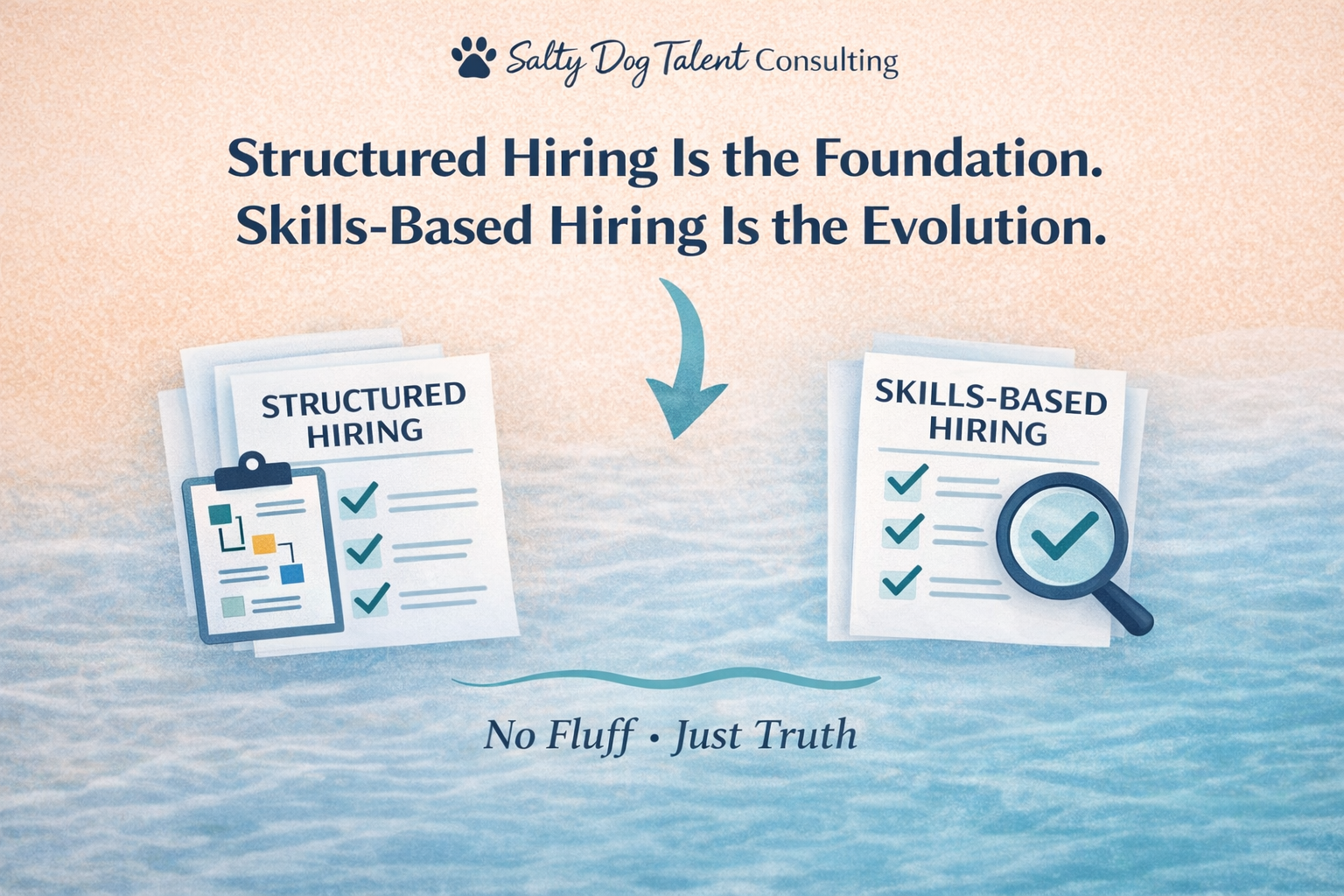
Structured Hiring Is the Foundation. Skills-Based Hiring Is the Evolution.
By Christine Sharma
Founder, Salty Dog Talent Consulting
Let’s start with a truth most companies don’t want to admit:
You cannot “do” skills-based hiring without structured hiring.
If your interviews are still:
Free-form conversations
Different for every candidate
Based on gut feel
Light on scorecards
Heavy on “culture fit”
You are not hiring for skills.
You are hiring for comfort.
And those are very different things.
What Is Structured Hiring (Really)?
Structured hiring is a disciplined, consistent approach to evaluating candidates against predefined criteria.
It includes:
Clearly defined role competencies
Interview questions aligned to those competencies
Standardized evaluation rubrics
Scorecards completed immediately after interviews
Calibration across interviewers
Structured hiring reduces bias.
It increases fairness.
It improves defensibility.
It makes hiring measurable.
And most importantly?
It makes hiring repeatable.
Why Structured Hiring Alone Isn’t Enough
Here’s where many organizations stop:
They implement scorecards.
They train interviewers.
They enforce documentation.
And they think they’re done.
But if the competencies themselves are vague — “leadership,” “communication,” “strategic thinker” — you haven’t truly operationalized performance.
You’ve structured the process.
You haven’t clarified the skills.
That’s where skills-based hiring comes in.
Turning Structured Hiring into Skills-Based Hiring
The evolution happens in three deliberate shifts.
1. Move from Traits to Observable Skills
Instead of:
“Good communicator”
“Executive presence”
“Culture fit”
Define:
Can present data-driven insights to senior leaders
Can translate technical concepts into business impact
Can navigate stakeholder disagreement and drive alignment
Skills must be:
Observable
Measurable
Behavior-based
If you can’t describe what it looks like in action, it’s not a skill — it’s a preference.
2. Anchor Every Interview to Demonstrated Capability
In a true skills-based structured interview:
Every interviewer is assigned 1–2 specific competencies.
Each competency has:
Defined success behaviors
Behavioral or situational questions
A clear scoring rubric
For example:
Competency: Data-Driven Decision Making
Question: “Tell me about a time you had to make a decision with incomplete data.”
What good looks like: Clear framework, quantified outcomes, risk awareness
What weak looks like: Vague story, no metrics, reactive reasoning
Now you’re evaluating capability — not charisma.
3. Close the Loop with Analytics
This is where most companies miss the opportunity.
If you want skills-based hiring to stick, measure:
Which competencies correlate to high performance
Which interviewers score consistently high/low
Scorecard completion rates
Quality-of-hire trends by competency
Early attrition by skill profile
When you connect interview data to performance data, you stop guessing.
You refine your hiring model based on evidence.
And that’s when talent acquisition becomes strategic.
The Salty Truth
Structured hiring is about consistency.
Skills-based hiring is about clarity.
Together?
They create accountability.
You can defend your decisions.
You can explain your rationale.
You can improve over time.
Without structure, skills-based hiring is a slogan.
Without skill clarity, structured hiring is paperwork.
But combined?
They reduce bias.
They increase diversity.
They improve ramp time.
They elevate performance.
And they protect your business.
What This Means for Growing Teams
If you’re scaling, here’s the real risk:
Fast hiring without structure leads to mis-hires.
Structured hiring without skill clarity leads to mediocrity.
But structured + skills-based hiring?
That’s how you:
Hire consistently across managers
Expand access to nontraditional talent
Increase quality-of-hire
Shorten time-to-productivity
Strengthen retention
And yes — you can still move quickly.
You just move intentionally.
Final Salty Thought
Hiring faster ≠ hiring better.
But hiring structured and hiring for skills?
That’s how you build teams that actually perform.
If you want help defining your competency framework, aligning interviews to real skills, and measuring what matters — that’s exactly what I do.
No fluff. Just truth.
Skills-Based Hiring: Why It’s All the Rage (And Why It’s Not Just a Trend)
By Christine Sharma
Founder, Salty Dog Talent Consulting
Let’s start with a salty truth:
Degrees don’t do the job.
Skills do.
For years, companies have hired based on credentials, pedigree, and “where someone worked before.” But the tide is turning — and fast.
Skills-based hiring isn’t just a buzzword. It’s a correction.
It’s organizations finally asking the right question:
“Can this person actually do the work?”
What Is Skills-Based Hiring?
Skills-based hiring shifts the focus from:
Job titles
Years of experience
Degree requirements
To:
Demonstrated skills
Measurable competencies
Practical ability to perform the job
Instead of screening out candidates who don’t check a traditional box, companies define what success actually looks like — and hire against that.
It’s structured.
It’s measurable.
It’s fairer.
And when done right, it’s powerful.
Why It’s Suddenly Everywhere
Here’s why skills-based hiring is gaining serious momentum:
1. Talent Shortages Are Real
When you restrict hiring to “10 years of experience and a specific degree,” you shrink your talent pool dramatically.
When you hire for capability, you expand it.
In a competitive market, that matters.
2. Degrees ≠ Performance
Research consistently shows that degrees are often poor predictors of job performance.
What does predict performance?
Relevant skills
Cognitive ability
Behavioral competencies
Structured interview evaluation
In other words — evidence.
3. It Supports Diversity and Access
Rigid credential requirements disproportionately exclude capable candidates from nontraditional backgrounds.
Skills-based hiring widens the door:
Career switchers
Self-taught professionals
Military veterans
Parents re-entering the workforce
Community college grads
Bootcamp graduates
When you hire for capability instead of pedigree, you create opportunity.
4. AI & Technology Make It Easier
Modern ATS platforms now allow you to:
Build competency frameworks
Tag roles to skill libraries
Use structured scorecards
Track skill gaps
Assess proficiency more objectively
But here’s the catch…
Technology doesn’t fix a messy process.
If your interviews are still unstructured and hiring managers “go with their gut,” adding a skills taxonomy won’t save you.
Process first. Tools second.
The Salty Truth About Skills-Based Hiring
Many companies say they’re doing it.
Few are actually doing it well.
True skills-based hiring requires:
1. Defining Success Clearly
What does a high performer in this role actually do differently?
Not the job description.
Not HR jargon.
What are the 5–7 core competencies that drive results?
2. Structured Interviewing
Every candidate must be evaluated against the same criteria.
That means:
Defined competencies
Behavioral questions aligned to each skill
Clear scoring rubrics
Complete scorecard usage
No “I just liked them.”
3. Measurable Calibration
If you want skills-based hiring to stick, you must measure:
Scorecard completion rate
Quality-of-hire metrics
Time-to-productivity
Interviewer consistency
Hiring manager calibration trends
If you’re not measuring it, you’re not managing it.
(You know how I feel about analytics 😉)
Skills-based hiring is NOT:
Removing all job requirements
Ignoring experience entirely
Replacing human judgment with AI
Lowering the bar
It’s raising the bar.
It forces clarity.
It removes noise.
It reduces bias.
It improves defensibility.
It drives performance.
Why This Matters for Growing Teams
If you’re scaling:
You cannot afford mis-hires.
You cannot afford long ramp times.
You cannot afford gut-based decisions.
Hiring based on defined, measurable skills improves:
Offer acceptance
Early performance
Retention
Hiring manager confidence
Recruiter credibility
It moves Talent from “order taker” to “strategic driver.”
And that’s where it belongs.
So… Is It Worth It?
Yes — if you commit to doing it properly.
Skills-based hiring isn’t a plug-in.
It’s an operational shift.
But when you build structured frameworks, align interviews to competencies, and measure outcomes?
That’s when you see real impact.
And that’s when hiring stops being reactive — and starts being strategic.
Final Salty Thought
The companies winning in today’s market aren’t hiring the most impressive resumes.
They’re hiring the most capable humans.
And capability is measurable.
If you’re ready to define it clearly — and build a process around it — reach out and I can help you realize the real competitive advantage.
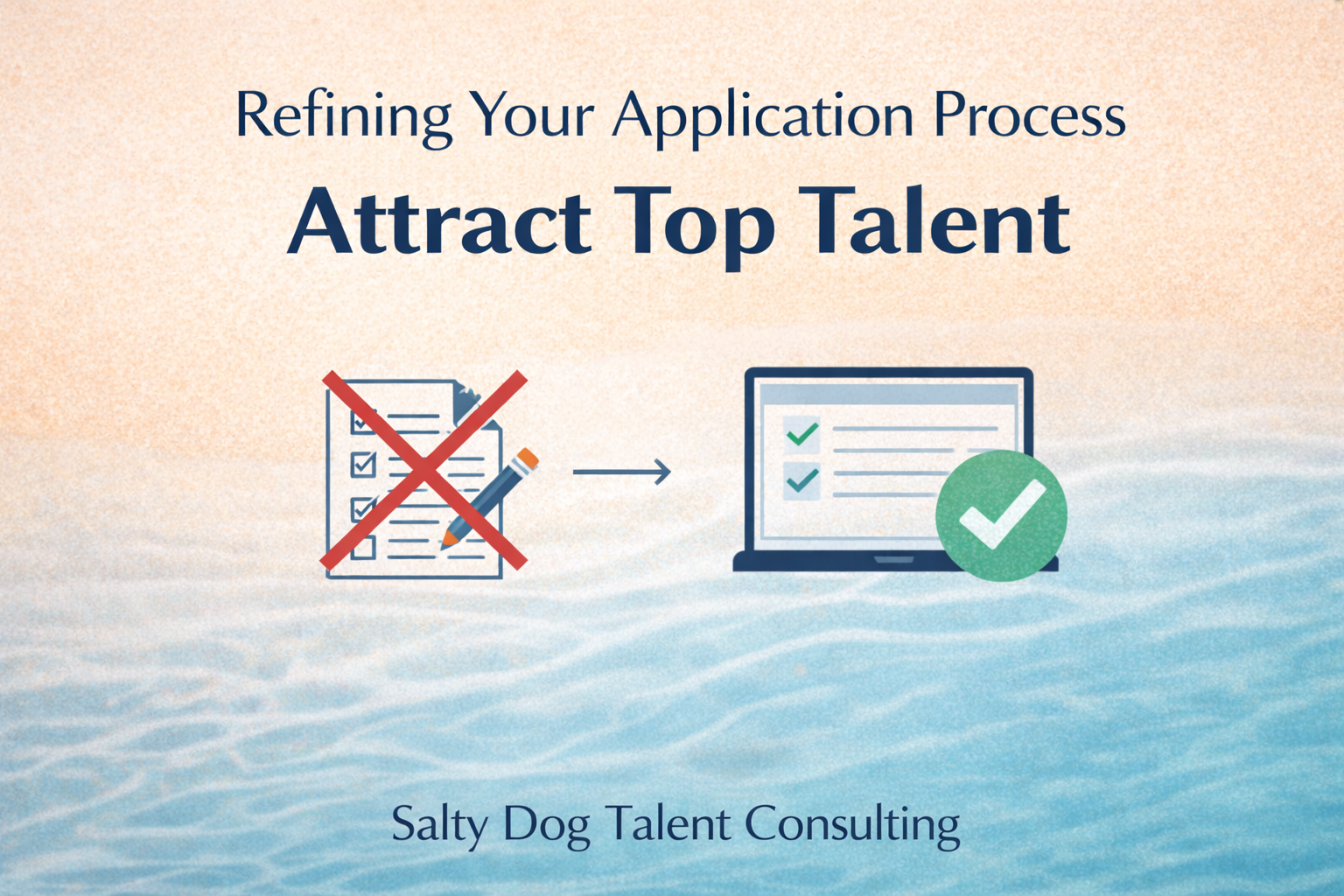
Your Application Process Is Costing You Top Talent
Your Application Process Is Costing You Top Talent
(And You Probably Don’t Even Know It.)
(And You Probably Don’t Even Know It.)
By Christine Sharma
Founder, Salty Dog Talent Consulting
Let’s talk about something uncomfortable.
You say you want top talent.
You say hiring is a priority.
You say candidate experience matters.
But your application process?
It’s long.
It’s clunky.
It requires a login.
It makes candidates re-type their entire resume.
And your best candidates? They’re quietly closing the tab.
The Hard Truth
Top talent does not chase friction.
High performers are often:
Already employed
Selective about where they apply
Evaluating you just as much as you’re evaluating them
If your application process feels like a tax audit, they’re gone in 90 seconds.
Not because they aren’t interested.
Because your process signals disorganization, inefficiency, and outdated thinking.
And those are not signals that attract strong operators.
Where Most Companies Go Wrong
Here’s what I see repeatedly:
❌ Mandatory account creation before applying
❌ 25+ required fields duplicating resume data
❌ Non-mobile friendly forms
❌ Vague job descriptions
❌ No clarity on salary ranges
❌ No timeline or expectations set
You may think:
“It’s just five extra minutes.”
But multiply that by:
A competitive job market
A passive candidate
A recruiter from another company who makes it easy
You lose.
What a Refined Application Process Looks Like
If you truly want to attract top talent, your process should be:
1. Frictionless
No login required to apply
Resume upload parses correctly
Minimal required fields
Mobile-friendly
Let candidates express interest in under 3 minutes.
If you need more data? Collect it later.
2. Transparent
Top talent wants clarity.
Include:
Salary range
Reporting structure
Location expectations
Hiring timeline
What success looks like in 6–12 months
Ambiguity repels experienced professionals.
3. Respectful of Time
If you require:
A portfolio
Work samples
A case study
Be explicit about when it will be requested and why.
And please — stop assigning unpaid multi-hour projects in early rounds.
You’re not just evaluating them. They’re evaluating your leadership maturity.
4. Designed for Humans (Not Just Compliance)
Many processes were built for:
Audit trails
Legal protection
“The way we’ve always done it”
But rarely for candidate psychology.
Ask yourself:
If I were a high-performing Director with options, would I complete this?
If the honest answer is no, it’s time to refine.
Data Doesn’t Lie
When companies streamline their application process, we often see:
Increased completion rates
Higher quality applicant pools
Shorter time-to-fill
Stronger employer brand perception
Better candidate survey scores
Sometimes the ATS isn’t the problem.
The process is.
A Simple Audit You Can Run This Week
Open your own job posting.
Apply to it from your phone.
Time yourself.
If it takes:
More than 5 minutes
More than one “why do they need this?” moment
More than one login prompt
You’ve found your first improvement opportunity.
Final Salty Truth
Top talent is not scared off by high standards.
They’re scared off by disorganized systems.
Refining your application process doesn’t lower the bar.
It removes unnecessary friction so the right people can walk through the door.
And in today’s market, that’s a competitive advantage.
If you’d like help auditing and modernizing your hiring process, that’s exactly what I do.
Salty truths. Smart hiring moves.
— Christine
Founder, Salty Dog Talent Consulting
Ethical AI in Hiring: How to Use It Without Losing Your Integrity
By Christine Sharma
Founder, Salty Dog Talent Consulting
AI is already in your hiring process — whether you realize it or not.
It’s screening resumes.
It’s suggesting candidates.
It’s helping draft job descriptions.
It’s summarizing interviews.
It’s even scoring assessments.
And here’s the truth:
AI is not inherently biased. But it can absolutely amplify bias if you’re not intentional.
At Salty Dog Talent Consulting, we don’t believe in fear-based narratives about AI. We believe in responsible implementation. AI is a tool. The question is whether your process is strong enough to guide it.
Let’s talk about how to use AI ethically — and how to ensure you’re being fair and unbiased while doing it.
1. Start With Structured Hiring — Not AI
If your hiring process is inconsistent, subjective, or loosely defined, AI will only make that chaos faster.
Before introducing AI tools, ask yourself:
Do we have clearly defined competencies for each role?
Are interview questions standardized?
Are scorecards tied to job-related criteria?
Do we know what “good” actually looks like?
AI should support a structured process — not replace one.
When hiring is grounded in defined skills and measurable outcomes, AI becomes a workflow accelerator instead of a bias multiplier.
2. Audit the Inputs — Garbage In, Garbage Out
AI systems learn from historical data.
If your historical data reflects:
Homogenous hiring patterns
Inflated requirements
“Culture fit” over job skills
Referral-heavy pipelines
…then your AI will learn that too.
Ethical AI use requires auditing your historical hiring data before layering automation on top.
Ask:
Who have we historically hired?
Who advanced through stages?
Who was rejected — and why?
Are there patterns across gender, race, school background, or career path?
You can’t fix what you don’t examine.
3. Keep Humans in the Loop
Fully automated decision-making in hiring is risky — and in some jurisdictions, legally problematic.
AI can:
Summarize interviews
Surface candidate themes
Suggest next steps
Highlight skill alignment
AI should not:
Make final hiring decisions
Auto-reject without review
Replace structured interviewer evaluation
Ethical AI means augmentation — not abdication.
You are still accountable.
4. Test for Adverse Impact
If you are using AI-driven screening, assessments, or ranking tools, you should be regularly evaluating for adverse impact.
That means measuring whether certain demographic groups are disproportionately filtered out at any stage.
Even if your tool vendor claims compliance, you still own the outcome.
At minimum:
Run quarterly audits on selection rates
Compare advancement rates by demographic group
Review any automated knock-out criteria
Fairness is not a one-time checkbox. It’s ongoing governance.
5. Be Transparent With Candidates
Trust is currency.
If you’re using AI tools in your hiring process, consider being open about it. Candidates increasingly expect transparency.
You might share:
That AI is used to assist with resume review or interview summaries
That final decisions are always made by humans
That your process is structured and job-related
Transparency reduces suspicion — and builds brand credibility.
6. Remove Bias Before You Add Technology
AI can help mitigate bias — but only if the foundation is clean.
Before turning on AI tools:
Remove unnecessary degree requirements
Define skills over pedigree
Standardize interview questions
Use consistent scoring criteria
Train interviewers on unconscious bias
Technology cannot fix a broken process.
But it can reinforce a good one.
7. Choose Vendors Carefully
Not all AI hiring tools are created equal.
Ask vendors:
How was your model trained?
What datasets were used?
How do you test for bias?
How often do you re-evaluate model fairness?
Can we access impact reports?
If they can’t answer clearly — that’s your answer.
The Salty Truth
AI is not the villain.
But lazy implementation is.
Ethical hiring isn’t about avoiding technology. It’s about building intentional systems where technology supports fairness instead of eroding it.
If your hiring process is:
Structured
Measurable
Transparent
Audited
Then AI can actually improve equity by reducing inconsistency and subjective noise.
But if your process is built on “gut feel”?
AI will simply automate your gut.
And that’s not progress.
Final Thought
The goal isn’t to remove humanity from hiring.
It’s to remove unnecessary bias.
Used well, AI gives your team more time to:
Focus on meaningful interviews
Evaluate real skills
Improve candidate experience
Make thoughtful, informed decisions
That’s ethical hiring.
And that’s the kind of momentum we build at Salty Dog Talent Consulting.
Salty Truth Friday: Your ATS Isn’t Broken. Your Process Is.
Most companies don’t have a software problem.
They have a discipline problem.
If:
Scorecards aren’t completed
Feedback is late
Roles stall in stages
Intake meetings are vague
Your ATS isn’t failing you.
It’s revealing you.
Technology does not fix behavior.
It exposes it.
Before you rip and replace your system, ask:
Is our hiring process clearly defined?
Are expectations documented?
Is accountability consistent?
Are we measuring stage timing?
If the answer is no, a new tool won’t save you.
Fix the system.
Then optimize the technology.
Takeaway:
Process before platform. Always.
Do You Actually Need an ATS Yet?
Here’s how to know.
By Christine Sharma
Founder, Salty Dog Talent Consulting
Not every company needs an Applicant Tracking System.
Yes, I said it.
For some businesses, an ATS is transformative.
For others, it’s premature.
The key isn’t headcount.
It’s complexity.
If you’re wondering whether it’s time to move beyond spreadsheets and inbox folders, here’s how to evaluate it honestly.
First: What an ATS Actually Does
An Applicant Tracking System (ATS) is a system of record for hiring.
It centralizes:
Job postings
Candidate pipelines
Interview stages
Feedback and scorecards
Communication
Reporting
It creates visibility and accountability.
But here’s the important part:
An ATS does not create process discipline.
It supports it.
If you don’t have even a basic hiring framework, software alone won’t solve that.
You Probably Need an ATS If…
1️⃣ You’re Hiring for 3+ Roles at the Same Time
Once you’re managing multiple pipelines simultaneously, email and spreadsheets start to break down.
You lose:
Version control
Feedback tracking
Candidate visibility
Decision speed
When hiring becomes multi-threaded, you need structure.
2️⃣ You’ve Missed Strong Candidates Because of Delays
If you’ve ever said:
“We meant to get back to them.”
“I didn’t realize we hadn’t sent feedback.”
“Wait, who owns this next step?”
That’s a system issue.
An ATS provides stage tracking and visibility so candidates don’t fall through the cracks — and your employer brand doesn’t suffer.
3️⃣ You Can’t Answer Basic Hiring Metrics
Can you confidently answer:
Average time-to-fill?
Interview-to-offer ratio?
Offer acceptance rate?
Where candidates drop off?
If not, you’re making hiring decisions without data.
And as you scale, that becomes risky.
4️⃣ Hiring Managers Are Inconsistent
If one manager:
Submits feedback immediately
And another:
Forgets entirely
You have variability.
Variability slows hiring and increases bias.
A structured system enforces consistency — which protects decision quality.
5️⃣ You’re Growing Past 25–40 Employees
Around this stage, hiring shifts from occasional to operational.
You’re not just filling roles — you’re building departments.
And once hiring becomes recurring, it needs infrastructure.
That’s when an ATS starts paying for itself.
You Might Not Need an ATS Yet If…
Let’s be honest.
If you:
Hire 1–2 people per year
Have a small, tight leadership team
Manage hiring collaboratively in a shared system
Have no plans to scale in the next 12–18 months
You may not need software yet.
What you likely need is:
A defined hiring process
Clear role scorecards
Structured interview questions
A repeatable intake template
Process first. Technology second.
The Real Question to Ask
Don’t ask:
“Should we buy an ATS?”
Ask:
“Is our hiring volume and complexity high enough to require infrastructure?”
Software is infrastructure.
And infrastructure should support growth — not create unnecessary overhead.
The Salty Truth
Buying an ATS too early creates frustration.
Buying one too late creates chaos.
The sweet spot is when:
Hiring is consistent
Complexity is increasing
Visibility is limited
Decisions are slowing down
That’s your signal.
If You’re Not Sure
This is exactly where I help.
At Salty Dog Talent Consulting, I help small and growing businesses:
Assess hiring maturity
Determine readiness for an ATS
Choose the right platform
Design structured processes before implementation
Avoid expensive, unnecessary tools
Because technology should create calm — not confusion.
If you’re wondering whether it’s time, it’s probably worth a conversation.

Why Your ATS Isn’t the Problem — Your Process Is
Technology doesn’t fix behavior. It exposes it.
By Christine Sharma
Founder, Salty Dog Talent Consulting
I’ve heard this sentence more times than I can count:
“Our ATS just isn’t working for us.”
Before we blame the system, let me ask a few questions.
Do hiring managers complete scorecards consistently?
Are interview stages clearly defined?
Is feedback submitted on time?
Are intake meetings structured?
Is anyone actually accountable for decision velocity?
If the answer to those questions is “not really,” then your ATS isn’t the issue.
Your process is.
The Hard Truth
An ATS is a system of record.
It is not:
A hiring strategy
A decision-making framework
A behavior management tool
A substitute for leadership
If your hiring process is inconsistent offline, it will be inconsistent online.
Technology doesn’t fix broken workflows.
It digitizes them.
And when broken workflows are digitized, they become more visible — which is often why leaders think the tool is failing.
It’s not.
It’s reflecting reality.
What’s Actually Happening
When companies feel frustrated with their ATS, it’s usually one of five things:
No structured interview design
Interviewers are improvising. Scorecards exist but aren’t aligned to competencies.Undefined ownership
No one owns stage movement. Roles stall.No intake discipline
The role isn’t clearly defined before interviews begin.Low accountability
Feedback deadlines are suggestions, not standards.Over-customization without strategy
The ATS has been modified endlessly without first defining a simple, scalable process.
None of these are software failures.
They’re operating model issues.
The Pattern I See Over and Over
A company buys an ATS.
They migrate data.
They configure stages.
They train recruiters.
Then they assume adoption will “just happen.”
But adoption is behavioral change.
And behavioral change requires:
Clear expectations
Leadership alignment
Consistent reinforcement
Measurable accountability
Without those, even the best platform in the world will feel clunky.
The Real Cost of Blaming the Tool
When organizations assume the ATS is the problem, they:
Rip and replace software unnecessarily
Spend thousands on new implementations
Burn out internal teams
Reset learning curves
Avoid addressing the actual root cause
Meanwhile, the process remains chaotic.
And chaos is expensive.
So What Is the Solution?
Before you evaluate new technology, evaluate your system.
Ask:
Is our hiring process defined end-to-end?
Do we have structured scorecards tied to competencies?
Are hiring managers trained?
Do we measure stage timing and feedback completion?
Is accountability clear?
If the process is clear and disciplined, most modern ATS platforms perform very well.
The tool should support the process — not define it.
The Salty Truth
Your ATS is not your strategy.
It’s your mirror.
If what you see in it feels messy, slow, or inconsistent, that’s not a technology failure.
It’s a signal.
And signals are useful — if you’re willing to address them.
How I Help
At Salty Dog Talent Consulting, I don’t start with the software.
I start with:
Workflow design
Structured hiring frameworks
Role clarity
Accountability standards
Hiring manager training
Then we align the ATS to support that system.
Because calm systems create confident decisions.
And confident decisions build strong teams.

5 Signs Your Hiring Process Is Costing You Money
It All Begins Here
And what to do about it.
By Christine Sharma
Founder, Salty Dog Talent Consulting
Most leaders don’t realize their hiring process is quietly draining revenue.
They assume hiring is expensive because recruiting is hard, talent is competitive, and growth costs money.
But more often than not, it’s not the market.
It’s the process.
If your hiring system isn’t structured, measurable, and intentional, it’s likely costing you far more than you think — in time, productivity, and actual dollars.
Here are five signs your hiring process may be leaking money.
1. You Don’t Know Your Time-to-Fill
If you can’t confidently answer:
How long does it take us to fill a role?
How long does each interview stage take?
Where do candidates stall?
You’re operating without visibility.
Every extra week a revenue-generating role sits open is lost output. Every delay in decision-making creates drag across the business.
And here’s the uncomfortable truth:
When time-to-fill is inconsistent, it’s usually a behavior issue — not a talent shortage.
Fix:
Track stage-by-stage movement. Hold hiring managers accountable for response times. Structure the process so decisions happen quickly and consistently.
Speed without chaos. Structure without bureaucracy.
2. Your Interviewers “Go With Their Gut”
Unstructured interviews feel efficient.
They’re not.
When interviewers ask different questions, evaluate different criteria, and rely on “culture fit,” you introduce bias and inconsistency — which leads to mis-hires.
A bad hire doesn’t just cost salary. It costs:
Manager time
Team morale
Re-recruiting expenses
Lost productivity
Often 30–50% of annual salary (or more)
Fix:
Implement structured scorecards tied to defined competencies. Train interviewers on what “good” actually looks like. Make hiring a decision process — not a vibe check.
3. You’re Still Managing Candidates in Spreadsheets
Spreadsheets work… until they don’t.
If resumes live in inboxes, feedback is in Slack, and decisions happen in hallway conversations, you’re creating operational chaos.
That chaos costs:
Duplicate work
Missed follow-ups
Lost candidates
Poor candidate experience
Recruiter burnout
And burnout is expensive.
Fix:
Implement the right Applicant Tracking System (ATS) for your size and complexity. But here’s the key: don’t just install software — design the process first.
Technology doesn’t fix behavior. It amplifies it.
4. Your Hiring Managers Say “We’re Just Not Seeing Good Candidates”
When every role feels “hard to fill,” the issue is rarely just sourcing.
Often it’s:
Unclear role definitions
Inflated requirements
Misaligned expectations
Poor intake meetings
No agreed-upon evaluation criteria
If five interviewers walk out with five different opinions and no shared rubric, you’ll spin in circles.
Spinning costs money.
Fix:
Run structured intake meetings. Define must-haves vs. nice-to-haves. Align on success metrics for the role before the first interview happens.
Clarity speeds everything up.
5. You Can’t Tie Hiring to Business Outcomes
If hiring feels reactive instead of strategic, that’s a red flag.
You should be able to answer:
Which roles drive revenue?
Which roles reduce risk?
Which roles create operational leverage?
What happens financially if this role sits open 60 days?
Hiring is not an HR function.
It’s a business function.
If it’s not tied to measurable outcomes, you’re making expensive guesses.
Fix: Connect hiring metrics to business KPIs.
Track:
Time-to-fill
Offer acceptance rate
Quality-of-hire indicators
Scorecard completion rates
Hiring manager responsiveness
When you measure it, you can improve it.
The Salty Truth
Most companies don’t have a talent problem.
They have a systems problem.
And systems problems are solvable.
When you implement structured hiring, clear accountability, and the right technology — your process becomes predictable. Efficient. Strategic.
And profitable.
If your hiring process feels chaotic, inconsistent, or reactive, it’s not a failure.
It’s just unfinished.
Ready to Fix It?
At Salty Dog Talent Consulting, I help small and growing businesses:
Choose and implement the right ATS
Design structured, repeatable hiring processes
Train hiring managers
Reduce time-to-fill
Improve decision quality