Is AI Blackballing Candidates Across Multiple Companies?
Recently, a study from Stanford sparked headlines suggesting that AI hiring tools may be creating an "algorithmic monoculture"—a world where candidates rejected by one company are more likely to be rejected by others using the same technology.
As often happens with studies like this, the headlines are a little scarier than the reality.
Let's talk about what's actually happening.
First: Companies Are Not Sharing Candidate Blacklists
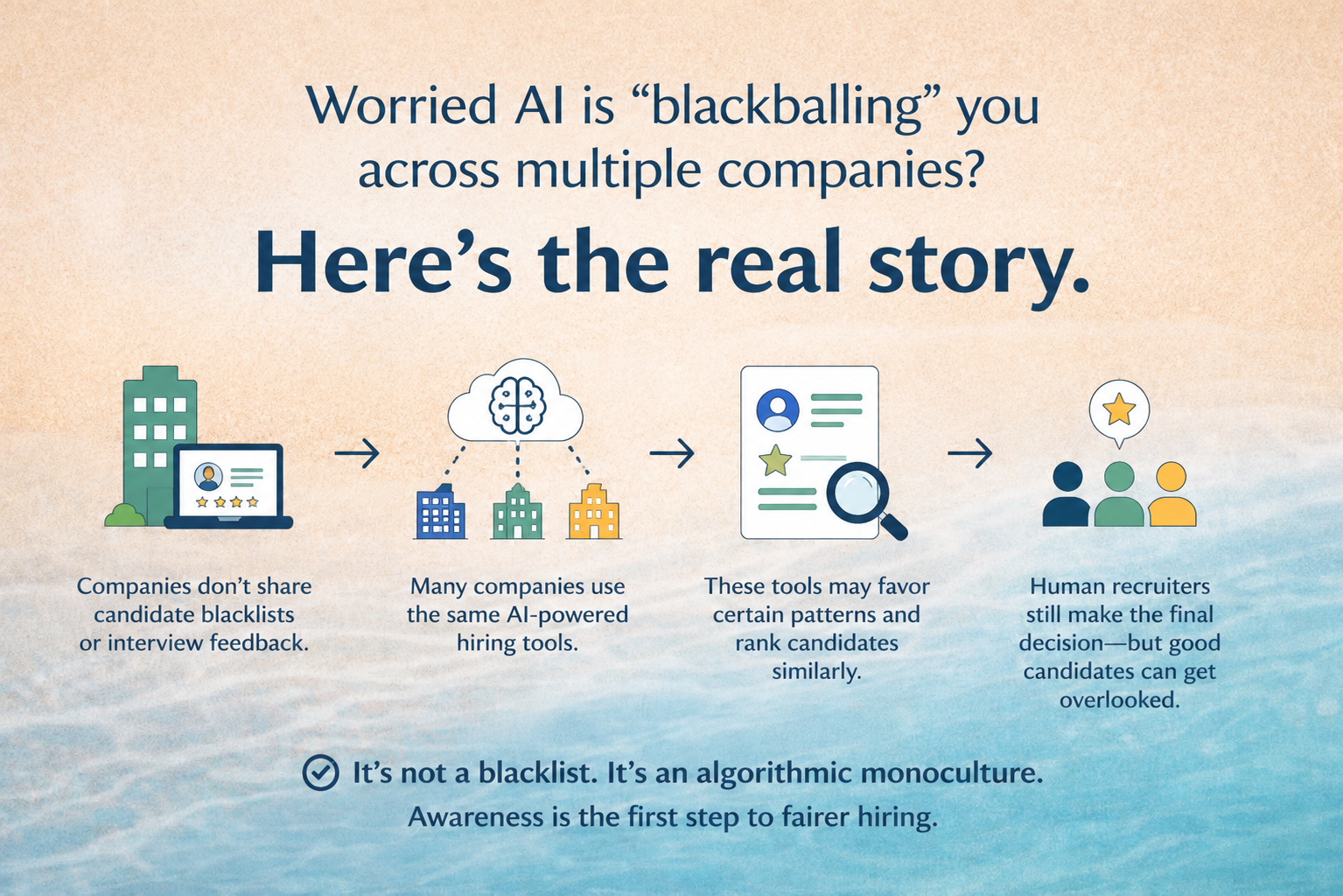
One of the biggest misconceptions I see is the idea that if Company A rejects you, that information somehow follows you to Company B.
In almost all cases, it doesn't.
Interview notes, recruiter feedback, hiring decisions, and candidate records are private to each employer. If you interviewed at one company and received feedback that you weren't the right fit, another employer cannot see those notes.
There is no giant database where recruiters are leaving comments about candidates for other companies to review.
So if you've been worried that one bad interview is following you around the job market, take a breath. That's not how modern recruiting systems work.
So What Is the Stanford Study Talking About?
The concern is less about shared information and more about shared technology.
Many organizations use the same third-party recruiting platforms, sourcing tools, and AI-powered matching systems. These tools may use similar models to determine which candidates appear to be strong matches for a role.
Think of it this way:
If 500 companies use the same recommendation engine, that engine may consistently favor certain career paths, educational backgrounds, job titles, or resume structures.
Candidates with more unconventional backgrounds may be ranked lower repeatedly—not because companies are sharing information about them, but because the same assumptions are being applied over and over again.
That's what researchers mean by an "algorithmic monoculture."
Could AI Learn From Previous Hiring Decisions?
Potentially, yes—but not in the way many people imagine.
Most AI vendors are not training their systems on your specific interview feedback from another employer.
However, some models may learn from aggregate hiring outcomes over time.
For example, if a system observes that certain profiles are consistently advanced, interviewed, or hired, it may become more likely to recommend similar profiles in the future.
The risk is not:
"Company A said this candidate wasn't good enough."
The risk is:
"The model has learned that candidates who look like this candidate historically get hired less often."
That's a subtle but important difference.
What This Means for Candidates
The good news is that most hiring decisions are still made by humans.
Despite what social media may suggest, AI is not secretly making final hiring decisions at most organizations. Recruiters, hiring managers, and interview teams are still responsible for deciding who advances through the process.
AI is typically being used to:
Surface candidates
Recommend matches
Summarize resumes
Prioritize applications
Assist recruiters with large applicant volumes
The challenge is ensuring that qualified candidates aren't overlooked simply because they don't fit a traditional pattern.
What This Means for Employers
The answer isn't to eliminate AI.
The answer is to use it responsibly.
Organizations should regularly evaluate:
How candidates are being surfaced
Whether nontraditional backgrounds are receiving consideration
Whether hiring outcomes show signs of bias
Whether recruiters are relying too heavily on recommendations
Whether humans remain actively involved in decision-making
Technology should help recruiters make better decisions—not make decisions for them.
The Bottom Line
The biggest takeaway from the Stanford study isn't that AI is blackballing candidates.
It's that when many organizations rely on the same technology, they may unintentionally overlook the same people.
That's a hiring challenge worth paying attention to.
But it's very different from the idea that candidates are being secretly tracked or blacklisted across employers.
As with most things in recruiting, the truth is more nuanced than the head
Need help navigating these new waters, please reach out! I would love to talk!
Christine Sharma
Founder: Salty Dog Talent Consulting
email: Christine@saltydogtalent.com